
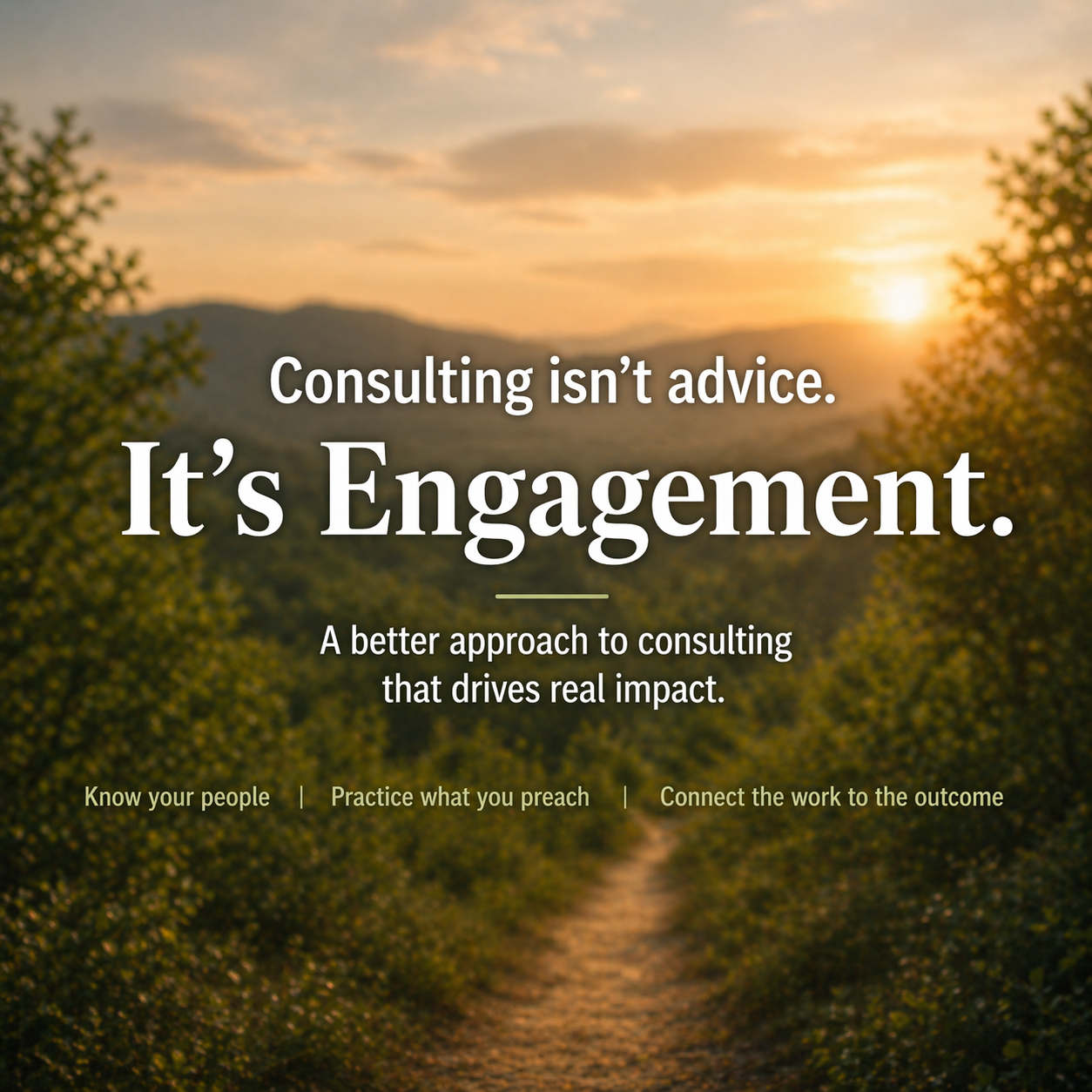
A more effective approach that drives real impact
Most consulting falls short, and not because of bad advice, but because it stops there.
- Advice without context rarely sticks.
- Advice without engagement rarely drives change.
Consulting Isn’t Advice. It’s Engagement.
Over the past year, as I’ve balanced coaching, mentoring, and consulting, I’ve refined an approach rooted in how I operated as a leader and what I learned working with other consultants. The result is a style that’s intentionally different from the norm.
Experience is part of it, of course. I have spent my career across operations, delivery, and client services, from individual contributor to executive leadership. However, experience alone does not create impact.
So what does?
Three fundamentals have consistently driven results and define how I partner with organizations:
- Practice what you preach
- Know your people and earn trust
- Connect the work to the outcome
Practice what you preach
Staying close to the work is not optional if you want to make the right decisions.
As I grew in leadership roles, I made it a non-negotiable to spend time in the trenches every day. That proximity gave me real visibility into what my team was experiencing and led to better decisions, stronger support, and a clearer vision across the full lifecycle of work.
This is where many consulting efforts fall short. It’s easy to recommend changes from a distance. It’s much harder, yet far more valuable, to step into the day-to-day and understand what’s actually happening. I know not every leader enjoys this level of context switching. I always did.
That’s what allows you to see where to act.
Know your people and earn their trust
You can’t understand a business by only talking to leadership.
I built relationships beyond org charts. One-on-ones weren’t limited to direct reports. I made time to connect across teams and functions, and that investment built trust that opened the door to better communication, stronger collaboration, and faster, more informed decisions.
In consulting, this matters more than most realize. Too many perspectives come from a small group of voices. Critical insight is everywhere, especially with the people closest to the work, but it’s easy to miss when the same voices (often the loudest at the top) take up all the space. Getting to it requires asking better questions, creating room for others, and listening without bias to understand how the work actually gets done.
Without that, you’re working with assumptions.
Connect the work to the outcome
Context creates accountability.
This is where many organizations miss a real opportunity.
Teams are given goals without context. Hit this number. Improve this score. Deliver this result.
But when people understand why those goals matter, something shifts. They see how their work connects to client success, financial performance, and the health of the business. That connection creates ownership, and ownership drives accountability.
I saw this consistently with high performing account and project teams. We didn’t just set targets like NPS or effective rates. We tied them to retention, growth, and long-term client value. Tradeoffs and decisions were always transparently shared.
When people understood the impact they had, their level of ownership changed. From here, performance follows.
At Emerging Trails, we partner with business leaders to get closer to the work, challenge the right things, and build solutions that actually stick.
If you’re thinking about how this shows up in your own organization, we’d be glad to talk it through.
Leave a Reply